
Relational Sustainability and Human Ecology: An Introduction
- Authors
-
-
Versanudin Hekmatyar
Politeknik Kesejahteraan Sosial BandungAuthor
-
- Keywords:
- Human ecology, Person-in-environment, Relational sustainability, Environmental governance, ESG, CSR, Community empowerment, Disaster and participatory governance
- Abstract
-
This introductory article outlines the intellectual foundation of Dharmadhikara: Journal of Human Ecology, launched amid escalating socio-ecological crises that link environmental degradation, climate change, institutional fragmentation, and social inequality. Grounded in the person-in-environment paradigm, it frames human ecology as both an analytical lens and an ethical project integrating sustainability, social justice, and moral responsibility. The five inaugural articles collectively operationalize this agenda: examining payment for environmental services as justice-oriented environmental governance, emotional wellbeing of older adults in institutional care, ESG-aligned CSR as an everyday inclusion and psychosocial intervention for Deaf youth, community-based economic empowerment as a relational socio-ecological process, and flood contingency planning as participatory, multi-level disaster governance. Together, they define the journal’s identity as interdisciplinary, ethically engaged, grounded in Global South realities, and committed to bridging theory, policy, and practice in pursuit of relational sustainability.
- References
-
Accenture. (2018). Getting to Equal: The Disability Inclusion Advantage. https://www.accenture.com/content/dam/accenture/final/a-com-migration/pdf/pdf-89/accenture-disability-inclusion-research-report.pdf
Azizah, C., Lizar, C. A., Robo, S., Zuraihan, Arsyani, I., Iqbal, M., Muharramsyah, R., & Ismahadi. (2025). Indigenous Wisdom in Flash Flood Adaptation and Mitigation: Insights from the Gayo Highlands, Indonesia. EGUsphere, 1–18. https://doi.org/10.5194/EGUSPHERE-2024-3774
Bebbington, A. (1999). Capitals and Capabilities: A Framework for Analyzing Peasant Viability, Rural Livelihoods and Poverty. World Development, 27(12), 2021–2044. https://doi.org/10.1016/S0305-750X(99)00104-7
Cashwell, S. (2024). Bringing Environmental Justice to the Practice Setting: Putting the Environment in Person-in-Environment. Journal of Human Rights and Social Work 2024 10:2, 10(2), 365–372. https://doi.org/10.1007/S41134-024-00323-1
Deci, E. L., Olafsen, A. H., & Ryan, R. M. (2017). Self-Determination Theory in Work Organizations: The State of a Science. Annual Review of Organizational Psychology and Organizational Behavior, 4(1), 19–43. https://doi.org/10.1146/annurev-orgpsych-032516-113108
Dewi, R. K., Izzati, R. Al, & Suryahadi, A. (2022). Disability and Labor Market Exclusion: Evidence from Indonesia. Sustainability Science and Resources, 2(1), 45–77. https://doi.org/10.55168/SSR2809-6029.2022.2004
Drolet, J. L., Lewin, B., Khatiwada, K., Bogdan, E., & Windsor, E. (2024). The role of social work practitioners and human service professionals in long-term disaster recovery after the 2016 Alberta wildfires in Canada. International Social Work, 67(6), 1449–1463. https://doi.org/10.1177/00208728241269680
Erikson, E. H., & Erikson, J. M. (1998). The life cycle completed. W.W. Norton.
Fitriyati, N., Arifin, H. S., Kaswanto, & Marimin. (2024). Towards a Resilient and Sustainable City: New Paradigm of Flood Disaster Governance Study Case Bekasi City. International Journal of Sustainable Development and Planning, 19(9), 3393–3404. https://doi.org/10.18280/IJSDP.190910
Gitterman, A., & Germain, C. B. (2008). The life model of social work practice: Advances in theory and practice. Columbia University Press.
Gunawan, P. V., & Dewi, L. A. N. (2025). Dynamics and Challenges of Emotional Relations of the Elderly in Social Service Institutions: Case Study in UPT PSTW Bondowoso. Dharmadhikara: Journal of Human Ecology, 1(1), 8–15.
Hekmatyar, V. (2025). ESG-Aligned CSR as a Person-in-Environment Intervention: Psychosocial Outcomes among Deaf Youth in Indonesia. Dharmadhikara: Journal of Human Ecology, 1(1), 16–24.
Howes, M., McKenzie, M., Gleeson, B., Gray, R., Byrne, J., & Daniels, P. (2010). Adapting ecological modernisation to the Australian context. Journal of Integrative Environmental Sciences, 7(1), 5–21. https://doi.org/10.1080/19438150903478597
Jänicke, M. (2008). Ecological modernisation: new perspectives. Journal of Cleaner Production, 16(5), 557–565. https://doi.org/10.1016/j.jclepro.2007.02.011
Jurado-Caraballo, M. Á., & Quintana-García, C. (2025). Disability inclusion in workplaces, firm performance, and reputation. European Management Journal, 43(5), 752–763. https://doi.org/10.1016/J.EMJ.2024.08.001
Kabeer, N. (2005). Gender equality and women’s empowerment: A critical analysis of the third millennium development goal 1. Gender & Development, 13(1), 13–24. https://doi.org/10.1080/13552070512331332273
Kegel, J. F., MacAfee, E., & de Jong, E. (2025). Desensitised flood risk perception to extensive disasters in a marginalised urban kampong in Indonesia. Environmental Hazards, 24(1), 91–112. https://doi.org/10.1080/17477891.2024.2343404
Khoiriah, S. A. (2025). Community-Based Economic Empowerment in a Human Ecology Perspective: An Analysis of the Pahlawan Ekonomi Nusantara Program in Indonesia. Dharmadhikara: Journal of Human Ecology, 1(1), 25–30.
Knight, B. G. (2004). Psychotherapy with older adults (3rd ed.). SAGE Publications.
Kosoy, N., & Corbera, E. (2010). Payments for ecosystem services as commodity fetishism. Ecological Economics, 69(6), 1228–1236. https://doi.org/10.1016/j.ecolecon.2009.11.002
Lipsky, M. (1980). Street-level bureaucracy : dilemmas of the individual in public services. Russell Sage Foundation.
Martin-Ortega, J., Ojea, E., & Roux, C. (2013). Payments for Water Ecosystem Services in Latin America: A literature review and conceptual model. Ecosystem Services, 6, 122–132. https://doi.org/10.1016/j.ecoser.2013.09.008
McAnally, K., & Hagger, M. S. (2024). Self-Determination Theory and Workplace Outcomes: A Conceptual Review and Future Research Directions. Behavioral Sciences 2024, Vol. 14, Page 428, 14(6), 428. https://doi.org/10.3390/BS14060428
Mol, A. P. J. (1995). The Refinement of Production. Ecological Modernization Theory and The Chemical Industry. Utrecht: International Books.
Mol, A. P. J., & Sonnenfeld, D. A. (2000). Ecological modernisation around the world: An introduction. Environmental Politics, 9(1), 1–14. https://doi.org/10.1080/09644010008414510
Noordwijk, M. Van, & Leimona, B. (2010). Principles for Fairness and Efficiency in Enhancing Environmental Services in Asia: Payments, Compensation, or Co-Investment? Ecology and Society, 15(4). http://www.ecologyandsociety.org/vol15/iss4/art17/
Pagiola, S., Arcenas, A., & Platais, G. (2005). Can Payments for Environmental Services help reduce poverty? An exploration of the issues and the evidence to date from Latin America. World Development, 33(2 SPEC. ISS.), 237–253. https://doi.org/10.1016/j.worlddev.2004.07.011
Priyanti, R. P., Asri, Lindayani, L., Kholis, A., Hidayah, N., & Kurdi, F. (2022). Sustainable Community-based Disaster Management for Flood in Indonesia. Malaysian Journal of Medicine and Health Sciences, 18(SUPP17), 371–376.
Rentschler, J., Klaiber, C., & Vun, J. (2021, April 21). Floods in the neighborhood: Mapping poverty and flood risk in Indonesian cities. World Bank Blogs. https://blogs.worldbank.org/en/eastasiapacific/floods-neighborhood-mapping-poverty-and-flood-risk-indonesian-cities
Riddell, R. C. (2014). Does Foreign Aid Really Work? An Updated Assessment. SSRN Electronic Journal. https://doi.org/10.2139/ssrn.2409847
Rogge, M. E., & Cox, M. E. (2001). The person-in-environment perspective in social work journals: A computer-assisted content analysis. Journal of Social Service Research, 28(2), 47–68. https://doi.org/10.1300/J079V28N02_03
Santrock, J. W. (2019). Life-span development. McGraw-Hill Education.
Sarifuddin, A. (2025). Payment for Environmental Services as a Sustainability Mechanism: Ecological Modernization and Social Ethics Perspective in the Cidanau Watershed. Dharmadhikara: Journal of Human Ecology, 1(1), 1–7.
Sen, A. (1999). Development as freedom. Alfred A. Knopf, Inc.
Subarkah, A. (2025). Socio-Ecological Vulnerability and Participatory Governance in Flood Contingency Planning: A Person-in-Environment Analysis of Labansari Village, Bekasi, Indonesia. Dharmadhikara: Journal of Human Ecology, 1(1), 31–39.
Surtiari, G. A. K., Dalimunthe, S. A., Sasaki, D., Maekawa, M., Yossa, N., Permana, Y. S., Afriansyah, A., Ningrum, V., Vibriyanti, D., Seftiani, S., Jibiki, Y., Hara, Y., & Nawawi. (2025). Social and Political Roots of Loss and Damage: A Study of Vulnerable Coastal Communities in Greater Jakarta. Journal of Disaster Research, 20(5), 710–725. https://doi.org/10.20965/jdr.2025.p0710
Todaro, M. P., & Smith, S. C. (2015). Economic development (12th ed.). Pearson.
Ungar, M. (2011). The social ecology of resilience: Addressing contextual and cultural ambiguity of a nascent construct. American Journal of Orthopsychiatry, 81(1), 1–17. https://doi.org/10.1111/j.1939-0025.2010.01067.x
Bronfenbrenner, U. (1979). The Ecology of Human Development: Experiments by nature and design. In The Ecology of Human Development. Harvard University Press.
Victor, C. R. ., Scambler, S. Jane., & Bond, John. (2008). The social world of older people : Understanding loneliness and social isolation in later life. Open University Press.
Wade, D. T., & Halligan, P. W. (2017). The biopsychosocial model of illness: a model whose time has come. Clinical Rehabilitation, 31(8), 995–1004. https://doi.org/10.1177/0269215517709890
Wallerstein, N. B., & Duran, B. (2006). Using Community-Based Participatory Research to Address Health Disparities. Health Promotion Practice, 7(3), 312–323. https://doi.org/10.1177/1524839906289376
Wisner, B., Blaikie, P., Cannon, T., & Davis, I. (2004). At Risk: Natural Hazards, People’s Vulnerability and Disasters (2nd ed.). Routledge.
Wister, A. V. (2019). Aging as a social process : Canadian perspective. Oxford University Press.
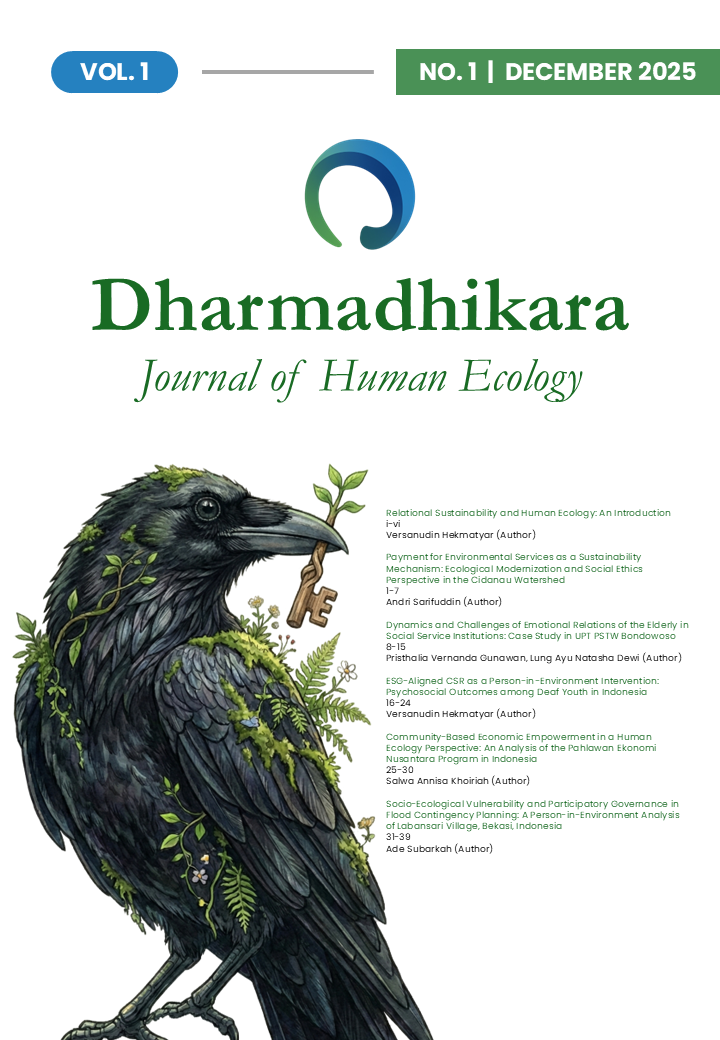
- Cover Image
-
- Downloads
- Published
- 12/30/2025
- Section
- Articles
- License
-
Copyright (c) 2025 Versanudin Hekmatyar (Author)

This work is licensed under a Creative Commons Attribution-NonCommercial-NoDerivatives 4.0 International License.

How to Cite
Similar Articles
- Salwa Annisa Khoiriah, Community-Based Economic Empowerment in a Human Ecology Perspective: An Analysis of the Pahlawan Ekonomi Nusantara Program in Indonesia , Dharmadhikara: Journal of Human Ecology: Vol. 1 No. 1 (2025): Dharmadhikara: Journal of Human Ecology
- Versanudin Hekmatyar, ESG-Aligned CSR as a Person-in-Environment Intervention: Psychosocial Outcomes among Deaf Youth in Indonesia , Dharmadhikara: Journal of Human Ecology: Vol. 1 No. 1 (2025): Dharmadhikara: Journal of Human Ecology
- Andri Sarifuddin, Payment for Environmental Services as a Sustainability Mechanism: Ecological Modernization and Social Ethics Perspective in the Cidanau Watershed , Dharmadhikara: Journal of Human Ecology: Vol. 1 No. 1 (2025): Dharmadhikara: Journal of Human Ecology
- Ade Subarkah, Socio-Ecological Vulnerability and Participatory Governance in Flood Contingency Planning: A Person-in-Environment Analysis of Labansari Village, Bekasi, Indonesia , Dharmadhikara: Journal of Human Ecology: Vol. 1 No. 1 (2025): Dharmadhikara: Journal of Human Ecology
- Pristhalia Vernanda Gunawan, Lung Ayu Natasha Dewi, Dynamics and Challenges of Emotional Relations of the Elderly in Social Service Institutions: Case Study in UPT PSTW Bondowoso , Dharmadhikara: Journal of Human Ecology: Vol. 1 No. 1 (2025): Dharmadhikara: Journal of Human Ecology
You may also start an advanced similarity search for this article.
Most read articles by the same author(s)
- Versanudin Hekmatyar, ESG-Aligned CSR as a Person-in-Environment Intervention: Psychosocial Outcomes among Deaf Youth in Indonesia , Dharmadhikara: Journal of Human Ecology: Vol. 1 No. 1 (2025): Dharmadhikara: Journal of Human Ecology